The Genomics and Bioinformatics Core Facility (GBCF) recently welcomed two new bioinformaticians to its staff: Bharat Mishra and Guangyuan (Frank) Li, both of whom are assistant professors of the practice in the Department of Biological Sciences. The GBCF provides essential services to a wide-ranging and multidisciplinary research community by leveraging cutting-edge technologies to facilitate comprehensive data acquisition for a variety of applications.
“We are thrilled to welcome Bharat and Frank to the GBCF team,” said Michael Pfrender, scientific director of the GBCF and professor and Interim Chair in the Department of Biological Sciences. “Both bring an exceptional blend of interdisciplinary technical mastery and a deep commitment to our pillars of research, service, and education, which will empower our researchers across campus to push the boundaries of biological discovery."
As core members of the GBCF team, both Mishra and Li support research across biology, including human disease, pathogen and vector genomics, neuroscience, ecology, and evolutionary biology, while also teaching student courses on bioinformatics and pursuing their own research portfolios.
“Whether we’re teaching in the classroom or working in the lab with faculty to support their research endeavors, we’re here to partner with scholars across campus,” Li said. “The GBCF is a small group of people with specific expertise, but that expertise lends itself to so many different disciplines and partnerships across experience levels.”
Mishra’s journey in pursuit of biological patterns
Both Li and Mishra bring a wealth of knowledge and a range of experience spanning biology, bioinformatics, and computer science to their new roles.
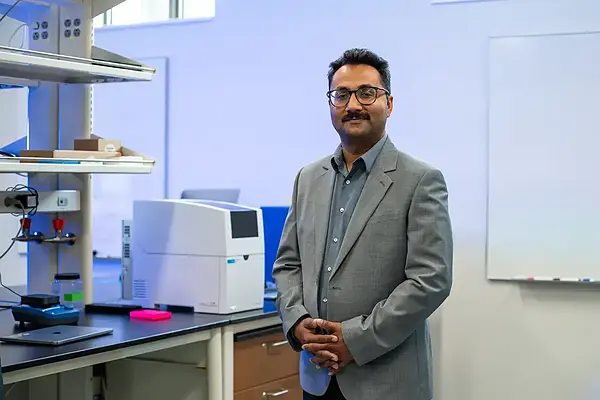
Mishra, who took up his position early last year, discovered a love for patterns in high school. Since he was studying biology, he thought about how to merge pattern-finding with natural systems, and ultimately began studying bioinformatics — a field that uses computer science, mathematics, and statistics to store, analyze, and interpret complex biological data like DNA sequences, and which was just emerging when Mishra began his undergraduate studies.
“Bioinformatics was unique at the time, and it was very cool to learn about something so new,” Mishra said. “But it’s also very computational-heavy, and I missed the foundational biology.” Originally from India, Mishra relocated to the University of Alabama-Birmingham (UAB) to pursue a doctorate in biology, where he applied his knowledge of computational techniques to model plant and animal systems.
While at UAB, Mishra also learned techniques for single-cell and spatial transcriptomics — a process that measures the RNA transcripts inside individual cells, revealing cellular differences that now-standard bulk sequencing misses — applying them in both plant biology and biomedical research collaborations.
Now, at Notre Dame, Mishra specializes in single-cell transcriptomics and computational systems biology, with a particular interest in applying single cell resolved systems biology to plant biology, an area that remains largely uncharted.
“There are so many different ways to apply a single analytical technique,” Mishra said. “I’m looking forward to engaging in a wide range of collaborations with researchers across disciplines, especially in biology, biochemistry, biomedical engineering and environmental science.”
Li’s passion bridges computer science and immunology
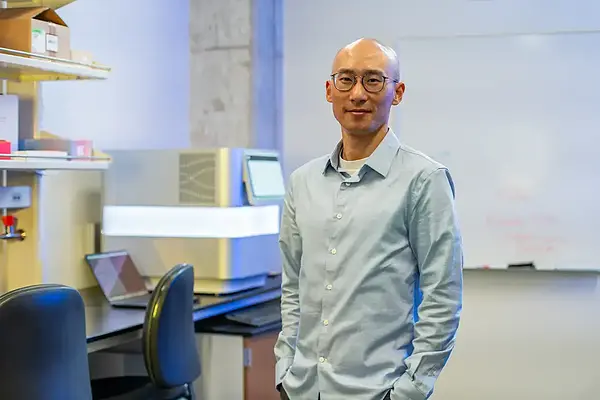
Li, who joined the University in early 2026, trained as a computer scientist at the University of Cincinnati and Cincinnati Children’s Hospital, where he gained an appreciation for the impact of computational analysis in human medicine. Desiring a deeper involvement with the translational process, he joined a lab at NYU focused on developing cancer immunotherapies.
“My time at NYU was quite immersive; I really learned the language of bench science to complement my computational knowledge,” Li said. “By drawing on my understanding of both languages — on the one side, machine learning, and on the other, immunology — I’m excited to bring scholars across disciplines together while I work closely with Notre Dame researchers to advance their discoveries.”
Li’s specialties include developing new artificial intelligence algorithms (AI), especially with applications to high-throughput mass spectrometry, and his work to date has resulted in widely adopted software tools, algorithms, and databases in the field. At Notre Dame, Li is looking forward to developing a research program that applies machine learning techniques to study and better understand the immune system’s response to different threats in the body such as cancer cells and infected cells, with potentially broad applications across biomedicine.
“I’m eager to continue innovating by collaborating with Notre Dame faculty from many different disciplines, including, but not limited to, biomedicine,” Li said. “There are so many new horizons to explore.”
Dedication to researchers of all levels
In addition to pursuing collaborative partnerships with University faculty, Mishra and Li also stressed the importance of training the next generation of scientists in cutting-edge computational techniques. As instructors, Mishra and Li teach courses in biocomputing and computational genomics for undergraduate and graduate students.
“Students see that the future of biology involves AI and computing,” said Mishra, who also engages students in his research projects. “Because of that, they want to learn computing and genomics, and we’re very excited to teach them.”
“We bear the responsibility of educating students and sharing what we know as they prepare for their own careers,” Li added. “We’re looking forward to working with - and learning from - the whole campus community, including students, trainees, and seasoned faculty.”
To learn more about the mission and services of the GBCF, including how to connect with Mishra and Li, please visit the GBCF website.
Contact
Erin Fennessy Lawlor / Writing Program Manager
Notre Dame Research / University of Notre Dame
erin.lawlor@nd.edu / +1 574-631-8183
research.nd.edu / linkedin.com/company/undresearch
About Notre Dame Research
The University of Notre Dame is a leading global Catholic research university located in South Bend, Indiana (USA). Inspired by its Catholic mission and founder Rev. Edward Sorin, C.S.C.’s vision for the University to be “one of the most powerful means for doing good” in the world, Notre Dame’s faculty and students pursue globally significant research, scholarship, and creative endeavor that advances discovery, fosters innovation, and drives lasting positive impact. For more information, please visit NDR's website or NDR's LinkedIn.